
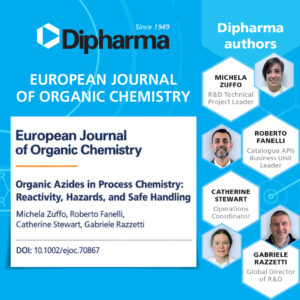
 Dipharma Francis S.r.l. (Dipharma), a leading Contract Development and Manufacturing Organization (CDMO) and a global manufacturer of Active Pharmaceutical Ingredients (APIs) and advanced intermediates, proudly announces the publication of the review “Organic Azides in Process Chemistry: Reactivity, Hazards, and Safe Handling” in the peer-reviewed European Journal of Organic Chemistry (EurJOC).
Azide chemistry provides access to important nitrogen-containing functional groups and heterocycles particularly useful in pharmaceutical synthesis, but the energetic nature and potential toxicity of these compounds pose specific challenges, especially when moving to manufacturing scale. Drawing on Dipharma’s extensive experience in the field, the article examines how these risks can be safely addressed throughout process development and industrialization.
Authored by Michela Zuffo, R&D Technical Project Leader, Roberto Fanelli, Catalogue APIs Business Unit Leader, Catherine Stewart, Operations Coordinator, and Gabriele Razzetti, Global Director of R&D, the work combines an overview of the synthetic potential of azides with practical considerations for their industrial use, including chemical compatibility, equipment selection at laboratory and plant scale, safe quenching and waste handling, as well as recent developments in continuous processing.
The publication is available at: https://doi.org/10.1002/ejoc.70867
It appears in the European Journal of Organic Chemistry (EurJOC), an international peer-reviewed journal covering a broad range of topics in organic chemistry, published on behalf of Chemistry Europe.
The expertise reflected in the review is part of Dipharma’s broader approach to azide chemistry and hazardous transformations, supporting customers in addressing the critical aspects involved in bringing challenging processes to industrial scale, from risk evaluation and process design to analytical control, containment, quenching and waste management.
Dipharma congratulates the authors on this publication and thanks all the colleagues who contributed to this work, which reflects the Company’s continued commitment to scientific knowledge sharing and
innovation in process chemistry.
“Dipharma’s experience in high-energy chemistry dates back to 1949, marking the beginning of more than 75 years of expertise in this highly specialized field,” said Gabriele Razzetti, Global Director of R&D at Dipharma. “Over the decades, we have built a structured approach to hazardous chemistry, combining process knowledge, safety assessment and industrial scale-up capabilities. This publication further strengthens our long-term strategy for azide control and reflects a depth of experience our customers can rely on when dealing with particularly challenging chemistry. Building on this expertise, we continue to explore advanced technologies such as continuous flow processing, which can offer important advantages in controlling the risks associated with hazardous reactions.”
“For our customers, the value lies not only in having access to specialized chemistry, but in knowing that with Dipharma it can be translated into a viable industrial process,” said Roberto Fanelli, Catalogue APIs Business Unit Leader at Dipharma. “Our experience allows us to assess opportunities and constraints early in development and help customers make informed decisions about the most appropriate path towards manufacturing.”