
By Malken Bayrakdarian, Vice President, Drug Discovery, Sygnature Discovery

Beyond the transactional view of chemistry
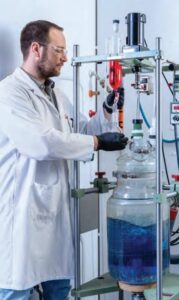 For much of modern drug discovery, chemistry has been approached as a sequence of steps. A compound is designed, made, purified and tested. In earlier programmes, slower timelines and simpler molecules made that process manageable, but the landscape is very different now. Programmes are more complex, timelines are shorter and the number of hand-offs between teams has increased. In this environment, a fragmented approach to chemistry is no longer sustainable.
Viewing chemistry as a set of discrete services creates friction where each transfer of knowledge between groups introduces risk and delay. Small gaps in understanding can become large bottlenecks once a compound moves from discovery into preclinical development.
In this article, Malken Bayrakdarian, Vice President, Drug Discovery, Sygnature Discovery, argues that integrated chemistry is essential for improving speed and predictability in small molecule development. Chemistry is a central function that links every part of discovery. It sits at the intersection of design, biology and data, shaping decisions that determine whether a molecule can advance. Positioning it as an integrated capability rather than a transactional service brings continuity, speed and better foresight. Integration streamlines discovery by eliminating unnecessary steps. Following this principle keeps projects moving smoothly from molecular design through to preclinical supply.
Understanding the inefficiencies behind fragmented chemistry
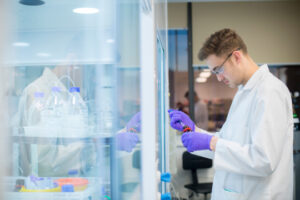 In most discovery programmes, the pressure to move fast exposes weaknesses in the way chemistry is organised. Projects that rely on multiple vendors or loosely linked teams face recurring challenges in knowledge transfer. Important details are lost between hand-offs and each group must spend time retracing work that has already been done. Such duplication seems minor in isolation, yet across a multi-year programme, it can cost weeks of progress and substantial budget.
Fragmentation often shifts priorities away from shared objectives. Chemists may be focused on compound design and synthesis, while biologists are waiting for material to progress screening or DMPK studies. Without shared visibility, a stop-start rhythm can form that slows data generation and decision-making.
Another frequent source of delay is purification. Separating purification from the rest of discovery tends to create bottlenecks. Compounds can sit in a queue while instruments are reconfigured or samples are transferred to another site. Each delay adds risk to the timeline and increases the chance that earlier design choices will need to be revisited.
Fragmented chemistry rarely fails because of poor science. It fails because of friction. As processes become more disconnected, promising molecules are more likely to lose momentum before they can be tested at the scale that matters.
The cost of these inefficiencies is rarely visible in a single milestone but accumulates throughout a programme. Repeated rework and data verification extend decision cycles, potentially delaying candidate nomination by several months. For smaller biotech companies operating within limited funding windows, that delay can determine whether a programme advances or pauses. From a strategic standpoint, avoiding these cumulative delays is as important as solving scientific challenges. Integrated chemistry enables momentum protection and reduces operational risk simultaneously.
How integration creates continuity in discovery
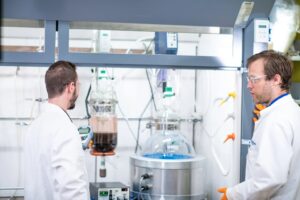 An effective chemistry strategy connects design, synthesis, purification and analysis within a single continuous workflow. The goal is not to expand the process but to remove barriers between the stages that already exist. Medicinal, analytical and process chemists working side by side, supported by shared data systems, every step informs the next. The outcome is a programme that can move smoothly from early structure–activity relationships to candidate nomination and preclinical scale-up.
The value of this connected approach is supported by fragment-based drug discovery research, where synthesis, screening and optimisation must operate as a single, feedback-driven cycle. The success of fragment-based campaigns depends on continuous communication between medicinal chemistry, biophysics and structural analysis [1]. The same logic applies across discovery more broadly: data and chemistry are most powerful when they evolve together.
Several principles guide an effective integrated chemistry model. Medicinal chemistry must be tightly linked to emerging biological and DMPK data, allowing teams to make design decisions in real time. Process development should be involved early enough to prepare for scale, so that synthetic routes and analytical methods can evolve with the project. Purification needs to be flexible and responsive, adapting to the behaviour of the compound rather than forcing the molecule to fit standard workflows.
High-throughput tools such as parallel synthesis and design-of-experiments can strengthen this model when they are used to generate the right data, not simply more data. Integration enables teams to shift efficiently between discovery and kilo scale while retaining full project context.
Tackling purification and process challenges early
Few parts of the discovery process create more disruption than purification. When a compound cannot be isolated at the right purity or scale, the entire programme slows down. Chemistry may be sound and synthesis complete, yet material still cannot be supplied for testing. These delays are not the result of poor planning but of systems that position purification as an afterthought rather than an integral stage of development.
The most common issues appear during the transition from analytical to preparative methods. A separation that works on milligram scale may not behave the same when moved to gram or kilo quantities. Columns overload, peak shapes distort and what seemed routine at the bench becomes a rate-limiting step. The challenges of translating bench reactions to larger scale have been analysed in depth, with choices in route design, solvents, mixing and isolation becoming dominant obstacles when moving from milligram to kilo quantities [2]. Dependence on a single platform or external vendor further amplifies these effects.
Building resilience into this stage requires access to multiple techniques and the expertise to use them interchangeably. The ability to pivot between analytical HPLC, preparative HPLC and supercritical fluid chromatography gives chemists the flexibility to solve problems quickly. This is particularly important when chiral resolution or separation of closely related isomers is needed.
Embedding purification and process chemistry from the outset allows scale-up to continue naturally from discovery. Time is saved, material flows more predictably and the science retains its pace.
In practical terms, a discovery engine built on integration focuses teams on results rather than individual tasks. Giving chemists, biologists and data scientists real-time access to analytical feedback allows project alignment to become less about status updates and more about informed decision-making. Teams can identify which chemical series to prioritise, anticipate scale-up needs and ensure material quality ahead of transfer to a CDMO. That shared frame of reference becomes an operational advantage, enabling faster transitions, fewer surprises and a more reliable path to candidate nomination. Chemistry’s role extends beyond service delivery to guiding strategic decisions in discovery.
Treating chemistry as a strategic capability
Positioning chemistry as a strategic function reshapes how discovery is planned and executed. As the central link between disciplines, it influences both compound design and programme efficiency. Integration across design, synthesis, purification and analytical development ensures that each decision draws on the full context of the project rather than isolated data points.
The impact of this integrated approach becomes clearer as timelines tighten and project priorities evolve. A connected discovery engine adapts more easily, maintaining momentum through change. Early visibility of scale-up requirements helps avoid rework, while shared analytical data builds confidence in compound quality. Close communication between medicinal and process chemists keeps material moving smoothly from discovery to preclinical supply.
This integration also strengthens the evidence base that supports development. Aligning every stage of the process enables faster, more reliable transfer to external partners such as CDMOs. Methods remain consistent, and material produced for toxicology or formulation studies meets expectations without extensive redevelopment. Together, these factors make chemistry the foundation of reliability and scalability in discovery. Organisations that adopt this approach convert scientific expertise into a durable competitive advantage.
Designing discovery with scalability in mind
Every discovery programme begins with uncertainty, but many of its later challenges are predictable. Scale-up delays, purification backlogs and knowledge loss between teams are not new problems. They persist because chemistry is too often treated as a sequence of separate tasks instead of a connected system.
A more sustainable model is one where chemistry, purification and process development are designed to work in parallel from the start. This approach creates continuity between exploratory research and preclinical production. It also makes projects more resilient to shifting priorities or emerging data.
The most successful programmes are those that anticipate what will be needed later and plan accordingly. Successful teams establish clear analytical methods early, build scalable routes as structure–activity relationships mature, and maintain open communication across scientific functions. The result is a process that moves without interruption from concept to candidate.
In the current discovery landscape, integration has become essential for maintaining speed, quality and long-term success. Chemistry built with the end in mind allows progress to stop depending on chance and becomes the natural outcome of a well-connected system.
References
- Kirsch P. et al., Molecules, 2019, 24(23), 4309. https://www.mdpi.com/1420-3049/24/23/4309
- Hitchin J. R., Nat. Rev. Methods Primers, 2022, 2, 28. https://www.nature.com/articles/s43586-022-00116-8